If push came to shove, could you spot a determiner? Could you spot the determiner in a sentence? Could you spot any determiner, all determiners or even this determiner?
If you’re not sure what we’re going on about here, you probably need to read on. Even if you do know, it could be well worth your while to read on anyway.
What is a determiner?
A determiner is a word used to modify a noun by letting the reader know more about that noun. A list of determiners would include articles, possessives, demonstratives, quantifiers, question words and even numbers.
For those who are unsure about any of those terms or would like some tips on how to identify determiners, we will unpack them shortly.
What position do they take?
Determiners always go before the noun. If it is a noun phrase in which the noun is preceded by an adjective or two or more, the determiner goes before that. For example, They began the long, slow, painful walk home.
Articles – definite article and the indefinite article
Articles are small words with a big job because they tell us more about the noun in question. The definite article is the word the – the cat, the breeze, the idea. Indefinite articles are less specific and could be a or an, depending on whether the next word begins with a consonant or vowel – a cat, a breeze, an idea.
Note that the use of a or an does not depend on whether the noun itself begins with a vowel or consonant, but the word that follows the determiner. So, you would write a big idea rather than an big idea. Similarly, you would write an old cat rather than a old cat.
Demonstrative determiners
Demonstratives give a better idea about which nouns you are talking about. They demonstrate whether you are talking about this noun, that noun, these nouns or those nouns.
Possessive determiners
Possessive determiners are like demonstrative determiners, only more personal. They include his, her, my, their, our and your.
Quantifiers and numbers for KS2 determiners
Quantifiers give an idea of how many nouns we are talking about – some nouns, each noun, every noun or few nouns. If you want to be more specific, the determiner can be a number – one noun, ten nouns, a hundred nouns and so on.
Question words
What is a determiner. That’s not a question but a statement of fact. Depending on the context, some question words can act as determiners – which determiner, what noun and whose choice, for example.
Pronoun or determiner?
One of the many pitfalls with determiners, especially when it comes to questions of grammar, is that the same word can act as a determiner or other class of word, such as a pronoun, depending on the context.
Consider these two sentences: This is lovely. I really like this secret beach.
In the first sentence, this is being used as a pronoun – it is taking the place of a noun.
In the second sentence, this is being used as a determiner. How do you know? Because it is placed directly before the noun phrase. Make sure your pupils can tell the difference. It might just help them when it comes to the SATs. More about that in a moment.
Putting these ideas into context
The national curriculum introduces the term determiner at Year 4, so this is when you could start drawing pupils’ attention to it. Of course, they will have been using them in their writing from the very beginning but they will need to be able to identify them as they progress up the school.
Our Year 4 Grammar Burst pack provides a series of five lessons designed to teach determiners in a memorable way, culminating in an extended writing task that enables children to put their knowledge into context.
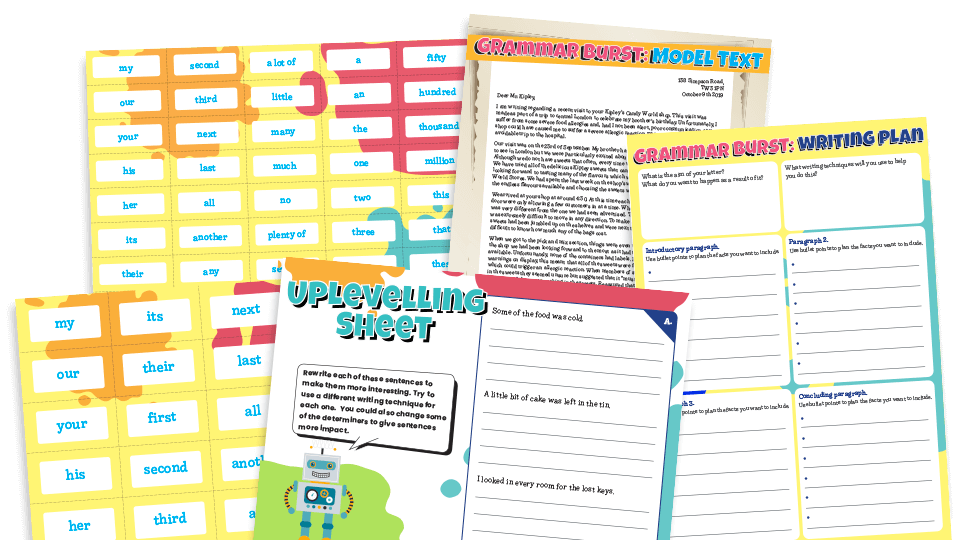
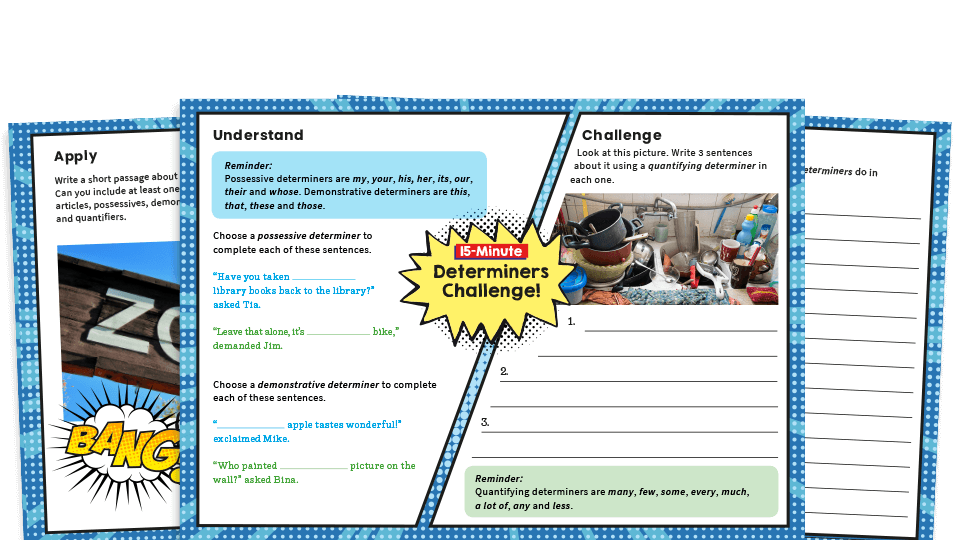
To really embed their skills, you could use our Y4 SPaG Challenge Mat which helps pupils to understand, challenge, test, explain and apply what they know through a series of visually appealing worksheets. That should save you a job or two!
Securing knowledge
As you would expect, this topic is bound to show up in the end of KS2 Grammar, Punctuation and Spelling tests. Determiners SATs questions can be as straightforward as circling the three determiners in a given sentence or correctly identifying the underlined word in a particular sentence as a determiner. In truth, they are usually not that complicated.
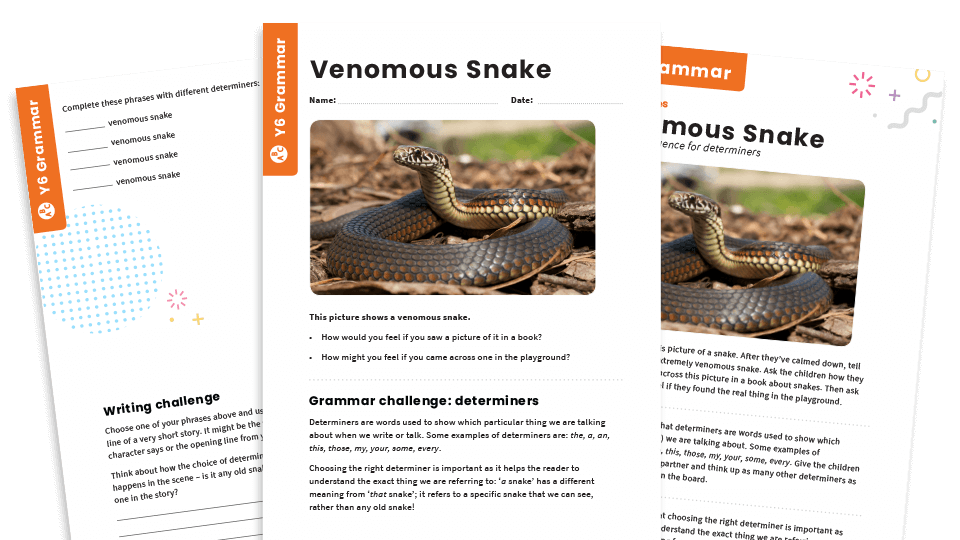
Even so, it is probably better that pupils have a more practical, working knowledge of them. Why not give your Year 6 pupils some targeted determiners practice through our Tricky Grammar Sentence Starters pack? This is one of a series of resources designed to revise a grammatical concept by means of a stimulating discussion before allowing pupils to apply their skills through a creative writing task.
Determiners KS2 in summary
Determiner examples
Julia’s dad bought her a football. The football was expensive! [‘the’ is a determiner and refers us back to a particular football]
the home team [article, specifies the team as known]
a good team [article, specifies the team as unknown]
that pupil [demonstrative, known]
Julia’s parents [possessive, known]
some big boys [quantifier, unknown]
List of determiners KS2
articles (the, a or an)
demonstratives (e.g. this, those)
possessives (e.g. my, your)
quantifiers (e.g. some, every)
Sue Drury qualified as a primary teacher in 1999. Teaching pupils from Year 1 to Year 8, she has held a variety of positions including maths and English subject leader, year leader, and assistant headteacher. Sue has mentored students and NQTs, offering guidance and advice using her years of experience. She created many of Plazoom's literacy resources.