When it comes to word classes, is your understanding as full as it should be? If you’re not sure, here are some gentle reminders along with some tips for developing a more secure grasp of this topic among your pupils...
What are word classes? – The basics
First things first, what are the different word classes? Be honest, did you struggle after noun, verb, adjective and adverb? Those main word classes are what the children need to know by the end of KS1.
According to the National Curriculum, they should be familiar with prepositions and conjunctions by the end of Year 3 and have grasped pronouns and determiners by the end of Year 4. And remember, that’s just word classes; there are plenty more technical terms they need to have absorbed before they leave KS2.
Word class definitions
Flick through a dictionary, scour the internet or ask AI – almost everywhere you look, each word class will have a slightly different definition.
This might be a controversial view, but you might want to arm the pupils with two different definitions for at least some of the word classes: an accurate one and a useful one.
For example, an adverb is sometimes described as ‘a word that modifies a verb, an adjective, another adverb or a sentence’. Try and say that to a KS1 pupil and you’re likely to be greeted with a blank look and possibly a gaping mouth.
Therefore, you might be wise to provide a shorthand explanation that will actually mean something to the poor child. ‘An adverb describes an action,’ for instance, might be more accessible. Or, how about, ‘They describe how, where or when something happened’?
Pupil-friendly descriptions
If you agree with the above, find a technically accurate definition of each of the word classes in question, so that you know they are getting the right information, then find a more pupil-friendly one.
You can make the wording your own or feel free to use the following:
- Adjectives describe things.
- Verbs are doing or being words.
- Nouns are the names of things.
- Pronouns stand in for nouns.
- Determiners come before nouns to show how they are being used.
- Prepositions tell us where things are or when they happened.
- Conjunctions connect words, phrases and clauses.
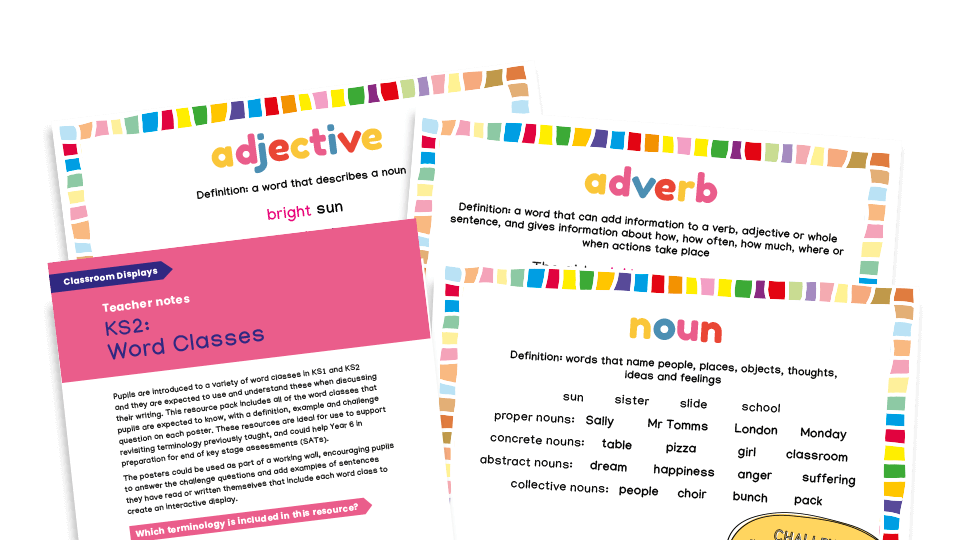
Why not create a crib sheet or poster that pupils can readily refer to, especially if you can include an example or two of each?
This KS2 word classes poster pack introduces and reinforces all key word classes, providing definitions, examples and challenge questions.
Word classes resources
It’s one thing for pupils to learn these definitions. It’s quite another thing when it comes to recognising word classes in writing.
Yet this is one of the main ways that their knowledge will be tested at the end of each Key Stage. Fortunately, we offer a range of word class resources to support you.
KS1 resources
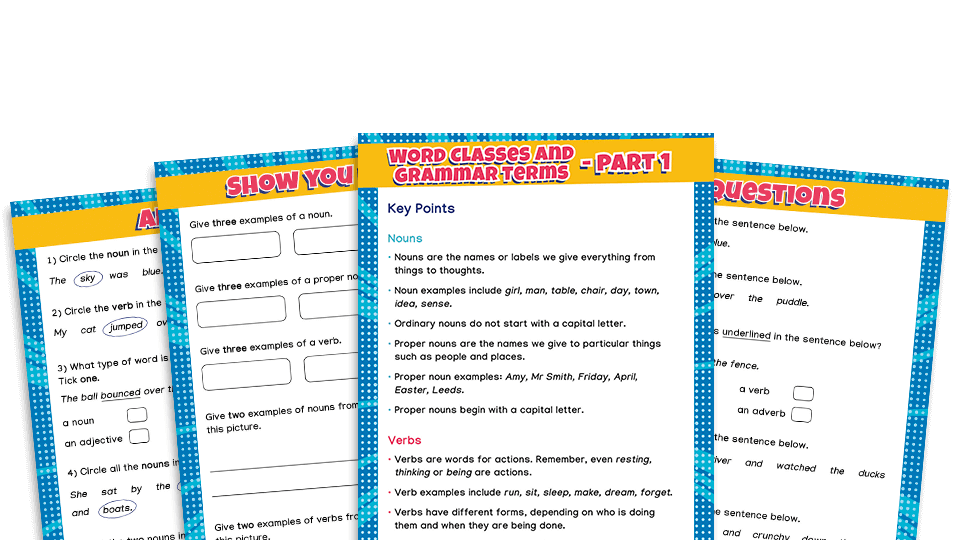
Support your class’s confidence in key grammar, punctuation and spelling skills with our KS1 GPS recap packs – ideal for classroom assessment, revision and transition into KS2.
As well as providing worksheets for pupils to practise on, they come with PowerPoint versions so that you can work through them with groups or as a class.
LKS2 resources
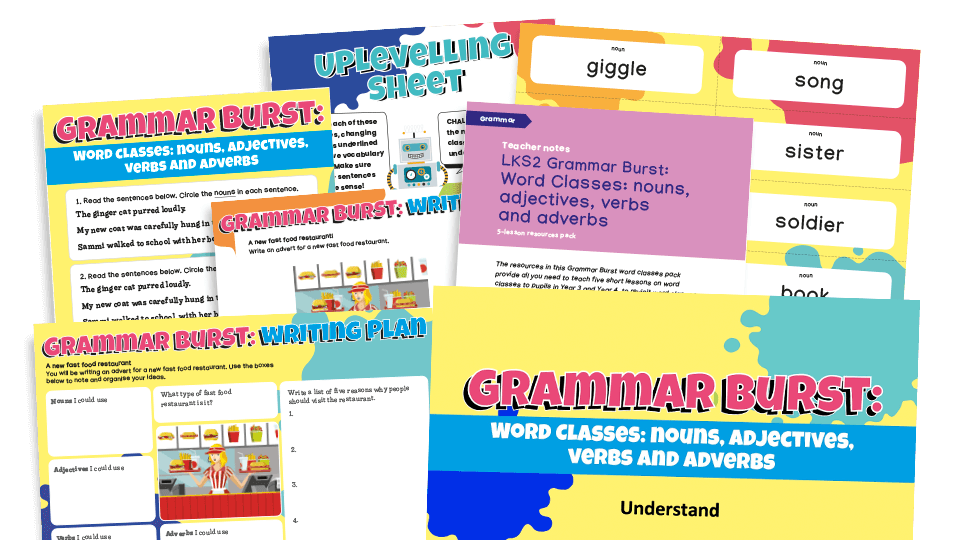
This Y3-4 grammar pack will help you teach five lessons on word classes, ending with an extended writing task to apply learning. It includes a PowerPoint, challenge worksheet, word class cards and a writing plan.
UKS2 resources
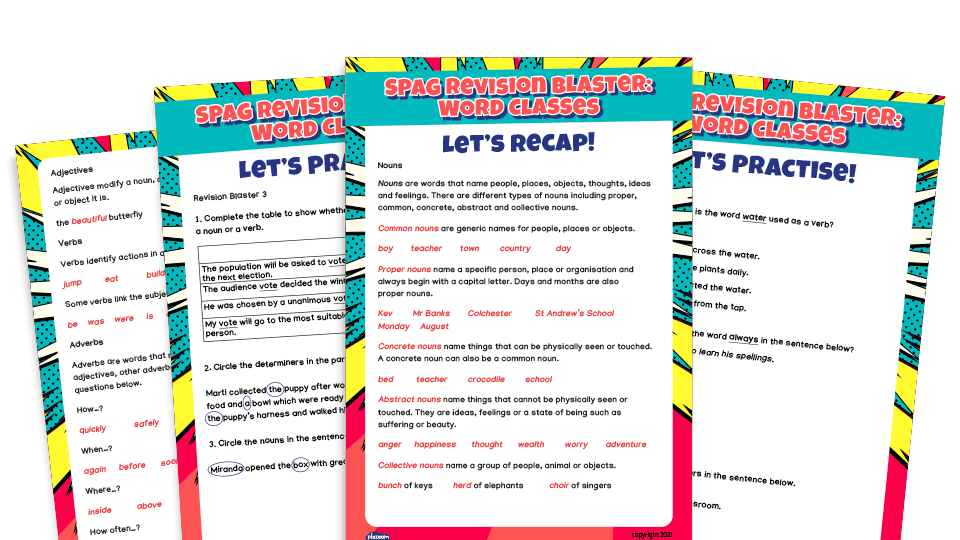
This Year 6 SPaG Revision Blaster helps pupils revise and apply key word classes through clear explanations and progressively challenging exercises. Ideal for SATs preparation, it includes PDFs, PowerPoint slides, worksheets and answer sheets.
Word class games and activities
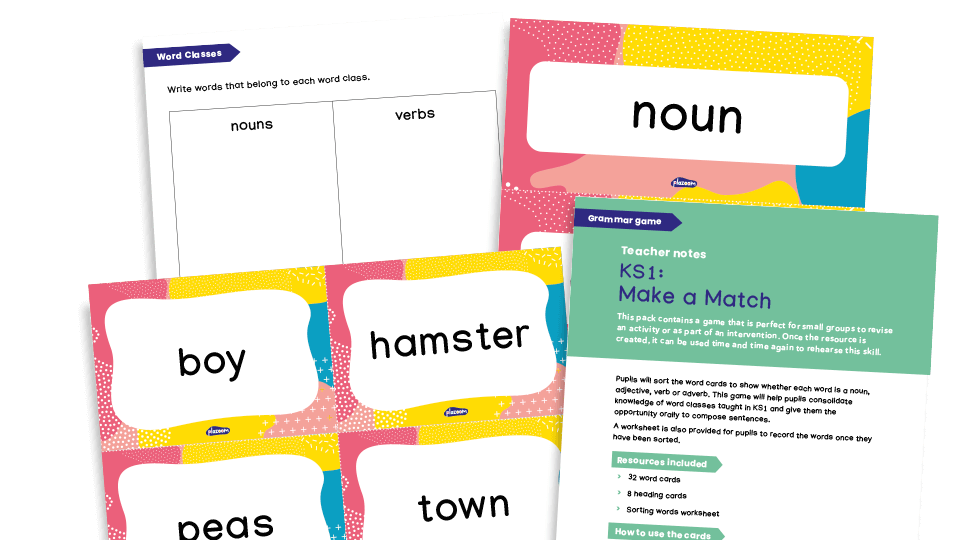
This ‘Make a Match’ game helps Year 2 pupils revisit and consolidate word classe through sorting and sentence-building activities. It includes 24 word cards, four heading cards and a sorting words worksheet. There's also versions for LKS2 and UKS2.
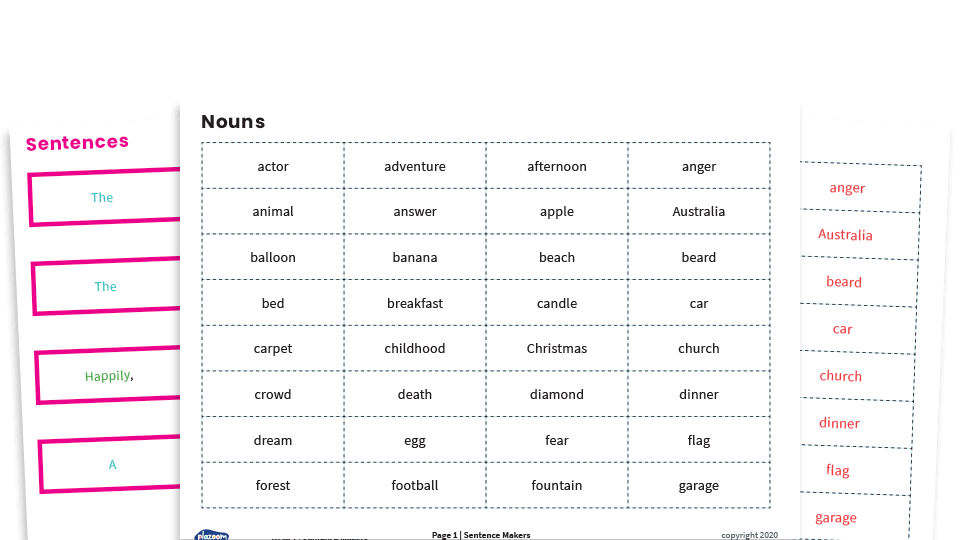
For KS2 children, try our sentence makers game, which covers all the terms covered here so far and throws in interjections for good measure. Wow!
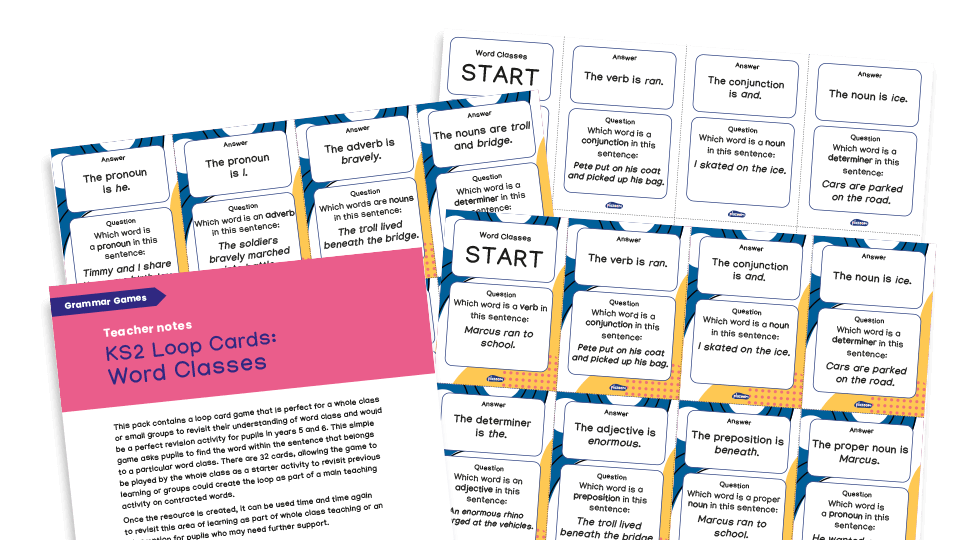
This KS2 word classes loop card game engages pupils in Y5-6 to identify word classes within sentences. The pack includes 32 cards and can be used to revisit and reinforce grammar knowledge.
Complications with word classes in English
Of course, nothing in life is straightforward and this applies to word classes as much as anything. For example, no sooner are KS1 pupils introduced to the concept of nouns than they are confronted with proper nouns, noun phrases, then expanded noun phrases.
Help them to see that they are just groups of words that take the place of a noun. In fact, they might help pupils get to grips with pronouns too as an extended noun phrase should be able to be replaced with a single pronoun such as it.
Similarly, adverbs are followed swiftly with adverbials, adverbial phrases and fronted adverbials. It will really help pupils to realise that groups of words can perform the same function as single words.
Word classes in context
Further complications are created by the fact that the same word can be more than one class, depending on the context. For example, set can be a verb, noun or adjective. Equally, the word before can be used as either a conjunction or a preposition.
Challenge your pupils not only to identify the class of a given word but also to explain how they know in terms of the role it is playing within the sentence.
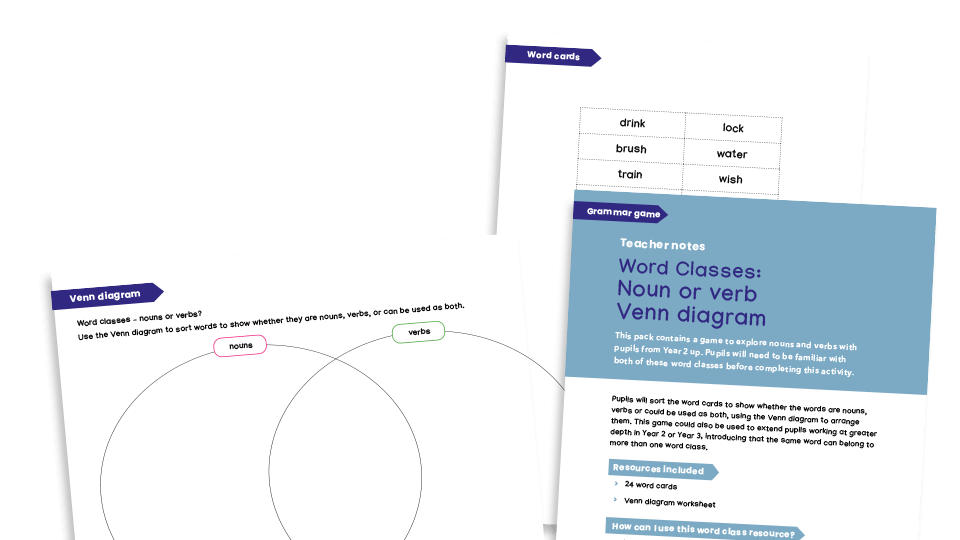
This KS2 activity helps pupils revisit nouns and verbs, exploring how some words can belong to both classes using a Venn diagram. It’s suitable for whole-class, small-group or intervention sessions and includes 24 word cards and a Venn diagram worksheet.
Morphology
Word classes can also be helpful in getting pupils to understand suffixes. When they are adding suffixes, make sure that they both understand any spelling rules and recognise how they change the class of the root word.
For example, the suffix -ful turns the noun success into the adjective successful. Equally, the verb manage turns into a noun with the addition of the suffix -ment.
Exceptions
A final word of warning, when discussing word class examples, take care not to slip into generalisations. The classic, of course, is the idea that adverbs end with -ly; they don’t, but you probably already knew that.
Equally, just because a word ends in -ly, that doesn’t make it an adverb. That would just be silly. And not all words that end in -ing are verbs.
Sometimes, that verb form acts as a noun, as in a meeting or a hearing. Once again, put the emphasis on getting your pupils to explain the function that each word is performing.
Sue Drury qualified as a primary teacher in 1999. Teaching pupils from Year 1 to Year 8, she has held a variety of positions including maths and English subject leader, year leader, and assistant headteacher. Sue has mentored students and NQTs, offering guidance and advice using her years of experience. She created many of Plazoom's literacy resources.