The expanded noun phrase is one of those features of writing that has become a ‘must have’ for pupils – one that maybe their teachers might not remember ever having learned about.
We can argue all we like about how well grammar was taught in years gone by. Perhaps there were some things that pupils were just encouraged or expected to use without being given a specific label.
As a result, the term ‘expanded noun phrase’ can cause a little confusion, self-doubt or even mild panic. Fear not, here are some tips to sharpen your subject knowledge and teach with confidence.
What is a noun phrase?
You know what a noun is, don’t you? Of course you do. A noun phrase is simply a group of words (actually, usually just a pair of words) that collectively does the job of the noun.
Typically, this involves nothing more complicated than including some sort of determiner. For example, car is a noun; a car is a noun phrase, as is the car, my car and this car.
So what is an expanded noun phrase?
An expanded noun phrase is simply a noun phrase that has more information added to it in order to clarify what you mean or provide a better description.
Here are some examples of expanded noun phrases:
- the lovely teacher
- a picture of my little, red car
- the centre of the universe
- a big, jam doughnut with cream on the top
Can you see what the original noun phrase might have been and, therefore, how it has been expanded?
The video from our Teaching Tricky Grammar series includes expanded noun phrase examples and activities for pupils to create their own expanded noun phrases, showing how this technique improves the clarity and quality of writing.
It is often useful to have a constant reminder of these points, which is why we’ve created a range of interactive SPaG displays to brighten up your classroom or corridors, using striking images and example text to help the concepts stick.

Why do expanded noun phrases matter?
First of all, think of what the examples above would be without expansion: this building, my car, the centre and a doughnut.
It’s clear to see how much more precise – and probably more interesting – the expanded ones are, with the extra detail.
For teachers, however, they are one of those things that pupils have to both know about and be able to produce as part of greater depth writing. They could also pop up in the end of KS2 Grammar, Punctuation and Spelling Test.
Modifying the noun
Having got that out of the way, you will want to know how to make an expanded noun phrase. The simplest approach is to describe the noun using modifying adjectives.
Contrary to some common belief, one adjective will do, as in a violent storm or a beautiful meadow.
However, it’s quite possible to add more than one, as long as you don’t get too carried away. For example, my annoying, smug cousin is acceptable, whereas the sweet, gorgeous, adorable, lovely, cute kitten is probably too much for anyone to stomach.
Prepositional phrase
Another way to create an expanded noun phrase is to add a prepositional phrase to it. Just to recap, a preposition is a word used to denote place, position, time or method, such as in, above, until, from and around.
A prepositional phrase is simply a phrase that includes a preposition and the noun to which it is referring, such as:
- the house across the street
- a time before television
- a secret land beyond the mountains
Simple, crucial punctuation
The main punctuation to worry about is the comma. When your expanded noun phrase includes a string of adjectives, you should separate each one with a comma, as you would with a list. For example, “I still remember that long, hot, idyllic summer.” or “She wore a red, white and blue dress.”
It is often important to hyphenate some words to avoid confusion. For example, consider the difference between a cheerful, green-fingered gardener and a cheerful, green, fingered gardener.
However, a hyphen would not normally be used to link an adverb ending in the suffix -ly to a verb to make a compound adjective, as in my strangely silent class.
Expanded noun phrases – Getting by at KS1
Generally speaking, it is enough for pupils to modify their nouns with one or two adjectives. Why not help your pupils to practise using our Year 2 SPaG challenge mat resource?
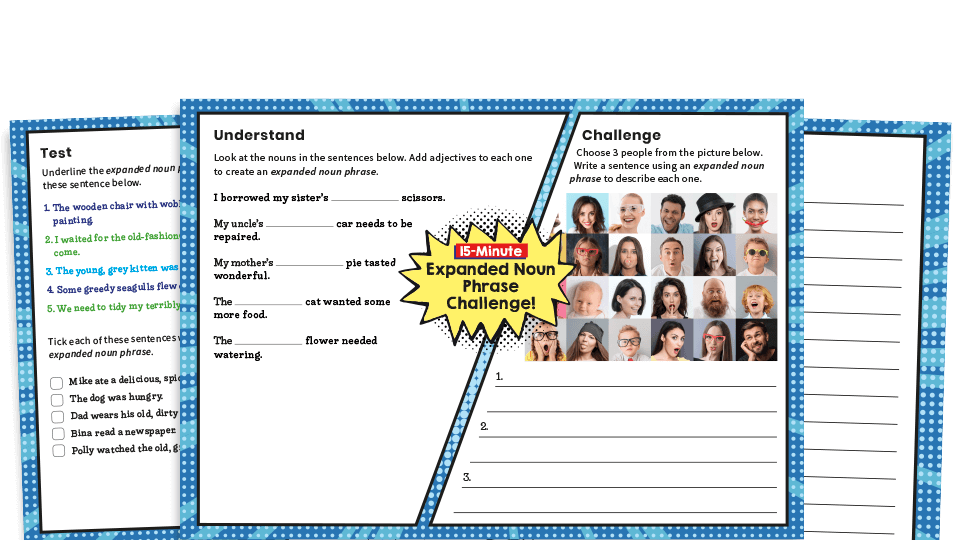
With any luck, you’ll soon be seeing lovely, appropriate expanded noun phrases popping up all over their writing.
Expanded noun phrases – Going further at KS2
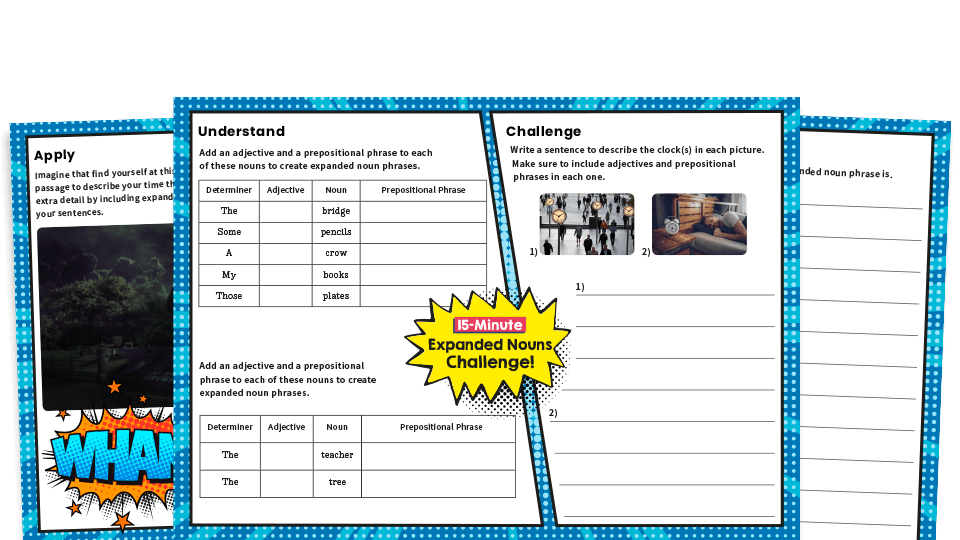
By Year 4, you should be expecting pupils to be using all sorts of expanded noun phrases, including those with prepositional phrases. To check their understanding, try our Year 4 SPaG challenge mat.
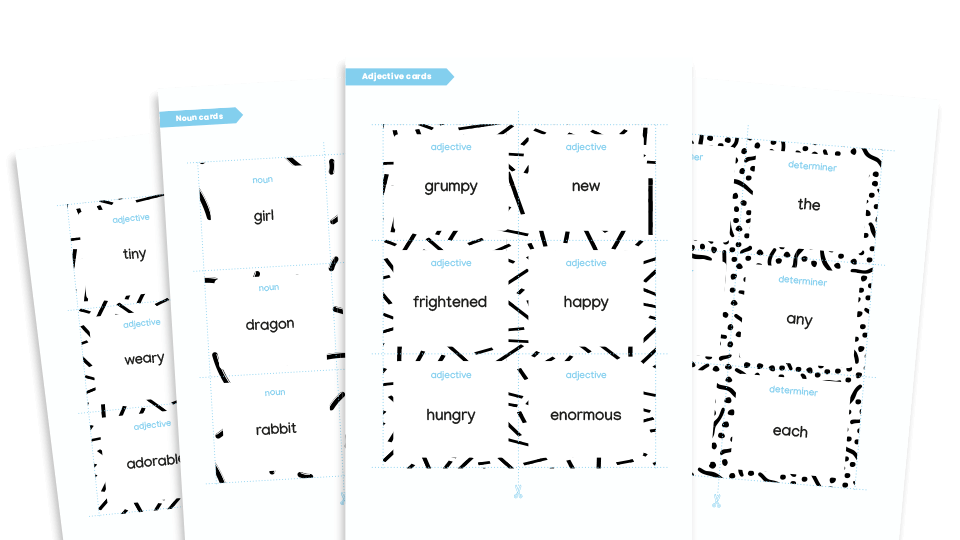
Meanwhile, this sentence builder game involves Year 4 pupils using the cards to build phrases, rehearse them in sentences and apply KS2 grammar terminology.
For a week’s worth of 15-minute teaching sessions on the topic, try our Year 4 Grammar Burst resources. Why not then include them as a specific requirement for suitable extended writing tasks?
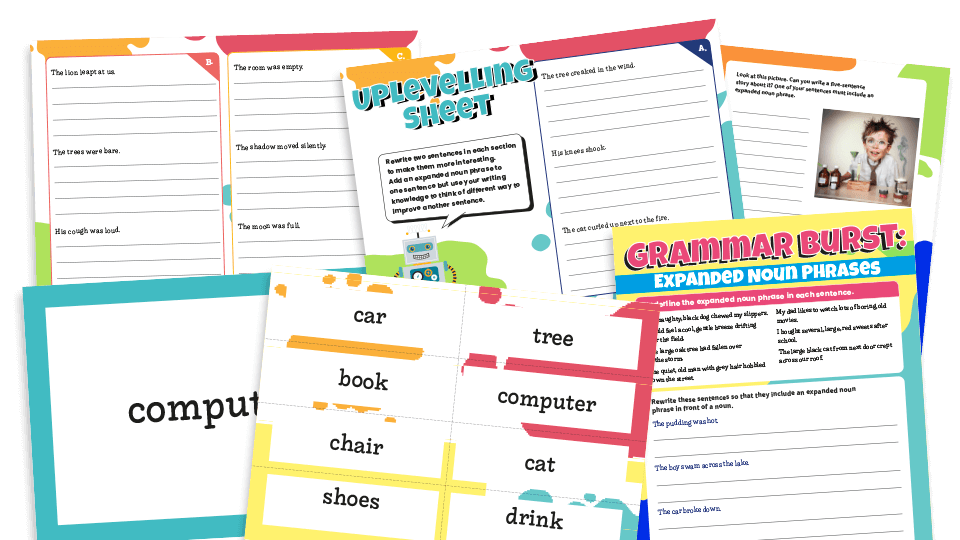
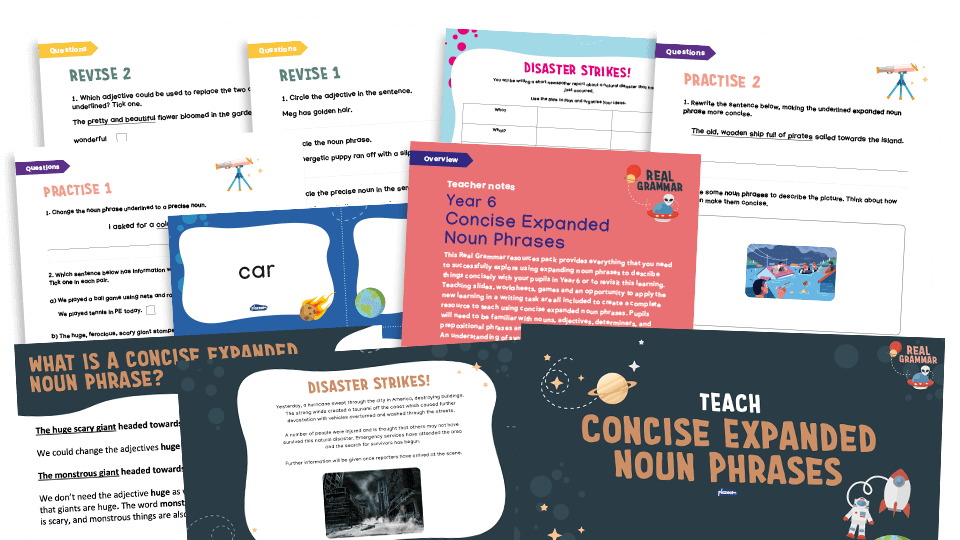
Our Real Grammar KS2 resource pack provides comprehensive materials to teach and practise using expanded noun phrases concisely, including teaching slides, worksheets, games and writing tasks.
Learning from your friends
Don’t just set using expanded noun phrases as a writing challenge; increase your pupils’ knowledge of this topic by using it as a feature to find when peer marking. Ask older children to check separately for examples that include prepositional phrases.
We hope this has been a timely, useful and stimulating reminder of the ins and outs of expanded noun phrases. Just for fun, can you work out the percentage of words in that last sentence that formed its expanded noun phrase?
Sue Drury qualified as a primary teacher in 1999. Teaching pupils from Year 1 to Year 8, she has held a variety of positions including maths and English subject leader, year leader, and assistant headteacher. Sue has mentored students and NQTs, offering guidance and advice using her years of experience. She created many of Plazoom's literacy resources.